6/23/2015 Sunrise hike 1


 No White-tailed Ptarmigan have been reported from Sunrise this year and I hoped to remedy that.
Years ago when the boys were in Pathfinders, I did a loop up over Third Burrows from Glacier Basin.
That hike from White River campground would have been reasonable had I started at a reasonable hour,
but I didn't leave the car till after three. Because of my late start I did the hike in reverse
figuring that it would be easier after dark to walk down the Glacier Basin trail than down from
Sunrise. I didn't see any White-tailed Ptarmigan but I did find
a couple of Pine Grosbeaks not far below the junction with with the trail from the Sunrise
parking lot. The grosbeaks were my 300th species for the year in Washington state, and with them I
achieved my primary birding goal for the year.
No White-tailed Ptarmigan have been reported from Sunrise this year and I hoped to remedy that.
Years ago when the boys were in Pathfinders, I did a loop up over Third Burrows from Glacier Basin.
That hike from White River campground would have been reasonable had I started at a reasonable hour,
but I didn't leave the car till after three. Because of my late start I did the hike in reverse
figuring that it would be easier after dark to walk down the Glacier Basin trail than down from
Sunrise. I didn't see any White-tailed Ptarmigan but I did find
a couple of Pine Grosbeaks not far below the junction with with the trail from the Sunrise
parking lot. The grosbeaks were my 300th species for the year in Washington state, and with them I
achieved my primary birding goal for the year.
I ate a late lunch at the Sunrise campground in the bright hot sunshine. A few tiny mosquitoes, very quick but fortunately not very hungry, kept me company. Anticipating them, I'd bathed in bug dope down at the parking lot so they didn't bother me much. Fox sparrows were singing at the next trail junction. The initial couple notes of the song are quite similar to the "whip three beers" call of an Olive-sided Flycatcher.
The snowpack melted a month early this year so the flowers are already out - magenta paintbrush, blue Veronica, Lupine and Fleabane and lots more. Around Frozen Lake the dwarf lupine and scarlet paintbrush are just starting to flower. I took pictures.


 Starting up First Burrows, I heard "jrp jrp" calls from a couple of good-sized finches flying across
the slope above me. They weren't Pine Grosbeaks and they weren't Cassins Finches or Red Crossbills.
I suspected they were rosy finches which would have been another year bird, but after they landed I
couldn't find them. Instead I saw a couple of mountain bluebirds, unusual this early at Sunrise
according to eBird. Approaching the top of First Burrows the trail crossed a a small patch of snow
steep enough that a track had developed around it. On top there were flowers amidst the sparse grass
but they weren't very showy. Like First Burroughs itself.
Starting up First Burrows, I heard "jrp jrp" calls from a couple of good-sized finches flying across
the slope above me. They weren't Pine Grosbeaks and they weren't Cassins Finches or Red Crossbills.
I suspected they were rosy finches which would have been another year bird, but after they landed I
couldn't find them. Instead I saw a couple of mountain bluebirds, unusual this early at Sunrise
according to eBird. Approaching the top of First Burrows the trail crossed a a small patch of snow
steep enough that a track had developed around it. On top there were flowers amidst the sparse grass
but they weren't very showy. Like First Burroughs itself.
Second Burroughs is a bit more of a mountain. Though just a flat-topped ridge, at least it's not a big plateau like First Burroughs. Third Burroughs actually has a identifiable peak but I didn't make it that far. It was 8 o'clock when I reached Second Burroughs so I hung out for a little while and admired the view before starting down the trail to Glacier Basin. Just past the top of Second Burroughs the flowers were dazzling but I didn't take any pictures because it was getting late. Next time.
Nice views of Rainier, and also a bull elk in velvet, from the trail down to Glacier Basin from Second Burroughs.


 Beyond the elk a mule deer was moseying through the woods, then a cow elk dashed across a meadow.
Most exciting though was a mama bear and cub(s) which suddenly appeared in the trail ahead of me at
dusk. I backed up out of sight and dug my flashlight out of my pack then waited five minutes before
starting cautiously down the trail again, singing and shouting and flashing my light all around. I
was glad that nobody but the bears was around to hear me. I thought maybe I heard them again, down
below the trail about where I'd seen them, but I kept up my racket for a good half-mile or more. In
an avalanche clearing not far beyond the bears I spotted their tracks in the sandy trail bed. At
first I was alarmed when the track seemed to be headed down the trail in front of me, then I was
reassured to see the tracks headed back up the trail behind me. Apparently they'd spent some time
foraging the clearing before I met them.
Beyond the elk a mule deer was moseying through the woods, then a cow elk dashed across a meadow.
Most exciting though was a mama bear and cub(s) which suddenly appeared in the trail ahead of me at
dusk. I backed up out of sight and dug my flashlight out of my pack then waited five minutes before
starting cautiously down the trail again, singing and shouting and flashing my light all around. I
was glad that nobody but the bears was around to hear me. I thought maybe I heard them again, down
below the trail about where I'd seen them, but I kept up my racket for a good half-mile or more. In
an avalanche clearing not far beyond the bears I spotted their tracks in the sandy trail bed. At
first I was alarmed when the track seemed to be headed down the trail in front of me, then I was
reassured to see the tracks headed back up the trail behind me. Apparently they'd spent some time
foraging the clearing before I met them.
Mt Rainier from White River, Third Burroughs on right
Forest below Sunrise
Below Frozen Lake junction
I ate a late lunch at the Sunrise campground in the bright hot sunshine. A few tiny mosquitoes, very quick but fortunately not very hungry, kept me company. Anticipating them, I'd bathed in bug dope down at the parking lot so they didn't bother me much. Fox sparrows were singing at the next trail junction. The initial couple notes of the song are quite similar to the "whip three beers" call of an Olive-sided Flycatcher.
The snowpack melted a month early this year so the flowers are already out - magenta paintbrush, blue Veronica, Lupine and Fleabane and lots more. Around Frozen Lake the dwarf lupine and scarlet paintbrush are just starting to flower. I took pictures.
Magenta Paintbrush Castilleja parviflora, Mount Rainier
Cusick's Speedwell Veronica cusickii, Mount Rainier
Cliff Paintbrush Castilleja rupicola, Mount Rainier
Second Burroughs is a bit more of a mountain. Though just a flat-topped ridge, at least it's not a big plateau like First Burroughs. Third Burroughs actually has a identifiable peak but I didn't make it that far. It was 8 o'clock when I reached Second Burroughs so I hung out for a little while and admired the view before starting down the trail to Glacier Basin. Just past the top of Second Burroughs the flowers were dazzling but I didn't take any pictures because it was getting late. Next time.
Nice views of Rainier, and also a bull elk in velvet, from the trail down to Glacier Basin from Second Burroughs.
Moss Campion Silene acaulis, First Burroughs
Rainier from trail down to Glacier Basin
Elk
6/25/2015 Sunrise hike 2


 Having neither found a Ptarmigan nor made it to Third Burrows two days ago, I decided to try again.
David joined me and we set out from Sunrise around 2 PM. Once again I had arrived at Sunrise closer
to sunset than to sunrise.
Having neither found a Ptarmigan nor made it to Third Burrows two days ago, I decided to try again.
David joined me and we set out from Sunrise around 2 PM. Once again I had arrived at Sunrise closer
to sunset than to sunrise.


 We ate our lunch in the car in the parking lot then hiked up to Second Burroughs via Sunrise
Campground and Frozen Lake. This time I stopped to photograph the flowers on Second Burroughs
before continuing on. David stayed at Second Burroughs to take a nap but the breeze and the
mosquitos alternately conspired to keep him awake so after a while he gave up and wandered around
taking photos. I kept track of him by his bright white shirt.
We ate our lunch in the car in the parking lot then hiked up to Second Burroughs via Sunrise
Campground and Frozen Lake. This time I stopped to photograph the flowers on Second Burroughs
before continuing on. David stayed at Second Burroughs to take a nap but the breeze and the
mosquitos alternately conspired to keep him awake so after a while he gave up and wandered around
taking photos. I kept track of him by his bright white shirt.


 The alpine flowers alone were worth the trip. Though there was some overlap, each summit had its
own character. Inconspicuous flowers on one, brilliant reds and yellows on two and mostly blues and
yellows on three.
The alpine flowers alone were worth the trip. Though there was some overlap, each summit had its
own character. Inconspicuous flowers on one, brilliant reds and yellows on two and mostly blues and
yellows on three.


 Again today I found no Ptarmigan but I did get several good views of Gray-crowned Rosy Finches, year
bird number 301. Unfortunately no photos of them but I did get photos of adult and juvenile Horned
Larks, birds of arid steppes which apparently find alpine meadows a close enough substitute.
Mountain goats were everywhere in herds and small groups. I counted more than two dozen adults and
most of them had kids. Having not seen any two days ago, I wondered where they all came from.
Again today I found no Ptarmigan but I did get several good views of Gray-crowned Rosy Finches, year
bird number 301. Unfortunately no photos of them but I did get photos of adult and juvenile Horned
Larks, birds of arid steppes which apparently find alpine meadows a close enough substitute.
Mountain goats were everywhere in herds and small groups. I counted more than two dozen adults and
most of them had kids. Having not seen any two days ago, I wondered where they all came from.


 The views of Mount Rainier were of course stunning. Despite having more than enough photos of
Rainier from previous trips, we couldn't resist taking more. Even on the way down we kept looking
over our shoulders at the mountain.
The views of Mount Rainier were of course stunning. Despite having more than enough photos of
Rainier from previous trips, we couldn't resist taking more. Even on the way down we kept looking
over our shoulders at the mountain.


 We left the Sunrise parking lot at 8:20PM and squeaked into Ranchitos in Enumclaw just before they
closed. I had a Negro Modelo, basically a cross between an amber ale and a Coke, with my chicken
enchiladas. It was a good day.
We left the Sunrise parking lot at 8:20PM and squeaked into Ranchitos in Enumclaw just before they
closed. I had a Negro Modelo, basically a cross between an amber ale and a Coke, with my chicken
enchiladas. It was a good day.
The three Burroughs Mountains
Flowers on Second Burroughs
Flowers on Third Burroughs
Trail up First Burroughs
Trail up Second Burroughs
Trail to Third Burroughs
Dwarf Mountain Lupine Lupinus lyallii, Second Burroughs
Alpine Yellow Fleabane Erigeron aureus, Third Burroughs
Cliff Paintbrush and Cinquefoil, Second Burroughs
Davidson's Penstemon Penstemon davidsonii, Second Burroughs
Pussypaws Calyptridium umbellatum, Third Burroughs
Tufted Saxifrage Saxifraga cespitosa, Second Burroughs
Horned Lark on Third Burroughs
Mountain Goat and kids on Second Burroughs
David on Second Burroughs
Rainier from Second Burroughs
Sarvent Spires and Goat Mountain from above Sunrise
Sunset at Sunrise
6/28/2015 Vesper Peak


 Several decades ago I hiked up Vesper peak and I remember white granite ledges and classic Cascades
alpine scenery. And also White tailed Ptarmigan. As I recall it wasn't a particularly difficult
hike, and didn't require scrambling, for which my nearly defunct arms are now ill-suited. The boys
and I hiked up as far as the lake last November and though I climbed up to the ridge above the lake
I didn't have time to get to the summit. Today I did.
Several decades ago I hiked up Vesper peak and I remember white granite ledges and classic Cascades
alpine scenery. And also White tailed Ptarmigan. As I recall it wasn't a particularly difficult
hike, and didn't require scrambling, for which my nearly defunct arms are now ill-suited. The boys
and I hiked up as far as the lake last November and though I climbed up to the ridge above the lake
I didn't have time to get to the summit. Today I did.


 Though the elevation and distance today were not much more than last week, the trail was rocky and
the ledges steeper than I remembered. Bugs were scarce but the temperature during the first couple
miles of the hike was almost stifling, as warm as any hike I can recall in the Cascades. The
scenery was great and I wished I'd started earlier so as to have more time to explore, but that will
have to wait for another trip.
Though the elevation and distance today were not much more than last week, the trail was rocky and
the ledges steeper than I remembered. Bugs were scarce but the temperature during the first couple
miles of the hike was almost stifling, as warm as any hike I can recall in the Cascades. The
scenery was great and I wished I'd started earlier so as to have more time to explore, but that will
have to wait for another trip.
My first real stop was at the hidden ice cave in the hanging valley, about 2 miles up the trail. The cave was quite spectacular last November when the boys and I explored it. Then it was perhaps 100 feet long and 30 feet wide with walls and ceiling of scalloped blue ice 8 feet overhead. Now it is collapsed, a jumble of rounded blocks of white ice. Apparently the collapse occurred within the past two weeks, based on some photos I found on the Internet. I found it hard to believe that the cave could have melted out so much since last November, but I guess with recent temperatures consistently in the 80's, even glacial ice goes fast.


 The switchbacks at the start of the climb to Headlee Pass were partly eroded away and a bit dicey in
running shoes. About half way up I thought I heard a couple of White-winged Crossbill calls but
couldn't verify them. Otherwise my bird list was pretty typical for the time and place.
The switchbacks at the start of the climb to Headlee Pass were partly eroded away and a bit dicey in
running shoes. About half way up I thought I heard a couple of White-winged Crossbill calls but
couldn't verify them. Otherwise my bird list was pretty typical for the time and place.
The trail up the ridge on the far side of the lake outlet stream is particularly scenic with scattered old Mountain Hemlock, outcrops of white granite and drifts of blue lupine and red mountain heath. The ledges began above a band of krumholz and are for the most part just gentle enough to walk up. I drank from icy snowmelt streams trickling down over the granite and admired the views across to Sperry and Glacier peaks and east to Big Snow Mountain and its neighbors. The area just below the summit is a true alpine garden with myriad flowers tended by a lone rosy finch. I parked in the lee of the summit crag and peered over the edge at the massive slab of rock plummeting into the cirque above Copper Lake. Nearly all the snow has already melted off the glacier which has yet another two months to bake in the summer sunshine. I marveled at the polished granite ridge between Vesper and Big Four and wondered if there is any way I could get over there to explore. I doubt it. I swapped photographer services with another hiker then explored a little around the summit before beginning my descent.


 The other hikers started down. A breeze rustled silently around the summit boulders and the clouds
overhead stood still. I photographed flowers, including a showy bluebell species which I don't
recall seeing before. The rosy finch came and went. A couple of goats ambled along the ridge to
the south but the Ptarmigan, if present, remained undetectable. I'll bet they were over to the
left, on the ridge above the lake which I didn't have time to explore.
The other hikers started down. A breeze rustled silently around the summit boulders and the clouds
overhead stood still. I photographed flowers, including a showy bluebell species which I don't
recall seeing before. The rosy finch came and went. A couple of goats ambled along the ridge to
the south but the Ptarmigan, if present, remained undetectable. I'll bet they were over to the
left, on the ridge above the lake which I didn't have time to explore.


Vesper Peak
Collapsed ice cave below Sperry Peak
Gray-crowned Rosy-Finch (Hepburn's), Vesper Peak
View NE from the Sunrise Mine trail, Vesper Peak
View NE from the Sunrise Mine trail, Vesper Peak
View NE from the Sunrise Mine trail, Vesper Peak
My first real stop was at the hidden ice cave in the hanging valley, about 2 miles up the trail. The cave was quite spectacular last November when the boys and I explored it. Then it was perhaps 100 feet long and 30 feet wide with walls and ceiling of scalloped blue ice 8 feet overhead. Now it is collapsed, a jumble of rounded blocks of white ice. Apparently the collapse occurred within the past two weeks, based on some photos I found on the Internet. I found it hard to believe that the cave could have melted out so much since last November, but I guess with recent temperatures consistently in the 80's, even glacial ice goes fast.
Vesper Lake and Sperry Peak
Gothic Peak from Vesper
Vesper Peak summit
The trail up the ridge on the far side of the lake outlet stream is particularly scenic with scattered old Mountain Hemlock, outcrops of white granite and drifts of blue lupine and red mountain heath. The ledges began above a band of krumholz and are for the most part just gentle enough to walk up. I drank from icy snowmelt streams trickling down over the granite and admired the views across to Sperry and Glacier peaks and east to Big Snow Mountain and its neighbors. The area just below the summit is a true alpine garden with myriad flowers tended by a lone rosy finch. I parked in the lee of the summit crag and peered over the edge at the massive slab of rock plummeting into the cirque above Copper Lake. Nearly all the snow has already melted off the glacier which has yet another two months to bake in the summer sunshine. I marveled at the polished granite ridge between Vesper and Big Four and wondered if there is any way I could get over there to explore. I doubt it. I swapped photographer services with another hiker then explored a little around the summit before beginning my descent.
Me on Vesper Peak
Copper Lake from Vesper Peak
Big Four Mountain from Vesper Peak
Edible thistle Cirsium edule, Vesper Peak
Pink Mountain-heather Phyllodoce empetriformis, Vesper Peak
Alaska Bellflower Campanula lasiocarpa, Vesper Peak
7/1-7/2015 Big Bend Trip

 I had no expectation of ever getting to Big Bend National Park until a week ago when I had John over
and he mentioned that he was going to spend a week there after the conclusion of a three-day
conference in Austin. Having just served him dinner perhaps I took unfair advantage by suggesting
at that point that maybe he would like company. He agreed that would be okay. All I knew about Big
Bend was that Lucifer hummingbirds and Colima warblers lived there and that they had a Marathon in
March which had always filled up before I'd gotten around to registering. Here is a
journal of my week in Big Bend with John.
I had no expectation of ever getting to Big Bend National Park until a week ago when I had John over
and he mentioned that he was going to spend a week there after the conclusion of a three-day
conference in Austin. Having just served him dinner perhaps I took unfair advantage by suggesting
at that point that maybe he would like company. He agreed that would be okay. All I knew about Big
Bend was that Lucifer hummingbirds and Colima warblers lived there and that they had a Marathon in
March which had always filled up before I'd gotten around to registering. Here is a
journal of my week in Big Bend with John.
Chisos Mountains from Paint Gap 1 campsite, Big Bend NP
Greater Roadrunner on limestone bluff, Big Bend NP
7/11/2015 Mountail Quail Redux


 Blair is attempting to photograph every species he sees in Washington this year. He is only missing
a half dozen or so, which is impressive considering that he is the #1 eBirder in the state with 327
species. BTW, I'm in the #2 place at the moment with 301 species. One of the species for which he
did not have a photo was Mountain Quail, so when he saw that I had reported one recently he gave me
a call. I suggested a day of birding together starting with a trip to the Port Orchard
airport/quarry to look for Mountain Quail.
Blair is attempting to photograph every species he sees in Washington this year. He is only missing
a half dozen or so, which is impressive considering that he is the #1 eBirder in the state with 327
species. BTW, I'm in the #2 place at the moment with 301 species. One of the species for which he
did not have a photo was Mountain Quail, so when he saw that I had reported one recently he gave me
a call. I suggested a day of birding together starting with a trip to the Port Orchard
airport/quarry to look for Mountain Quail.
We parked at the usual spot M+ across Sidney Rd SW from SW Lakeway Blvd and hiked west up the track towards the old clear-cut. Since my last visit the track has been bulldozed all the way to the quarry, completely eliminating the need to bushwhack. Convenient for access, but the development it portends probably spells the end for the Mountain Quail population on the site. I don't know where else to find them, but on the other hand a year from now I probably won't be looking for them any longer. Today we saw three and we both got photos of one of them. We also saw a coyote, Public Enemy Number One from the quail's perspective, down in the quarry within 100 feet of where we saw the quail.


 I was looking for a Semipalmated sandpiper. They're coming through with Western and Least sandpipers but
I haven't seen one yet this year. First we tried the Hylebos bridge M+
in Tacoma, a spot I recognized once we got there. At first we didn't see much, then we found a
flock of Western and Least sandpipers roosting out on the point. They allowed us to get very close
and I took lots of photos. The Westerns are still mostly in breeding plumage so they have varying
amounts of rufous on the crown and scapulars. That distinguishes them from Semipalmated sandpipers
which have no rufous. The Least sandpipers were much darker brown than I expected, with little
evidence of the buffy scapulars by which I usually identify them. There were no Semipalmated
sandpipers in the flock.
I was looking for a Semipalmated sandpiper. They're coming through with Western and Least sandpipers but
I haven't seen one yet this year. First we tried the Hylebos bridge M+
in Tacoma, a spot I recognized once we got there. At first we didn't see much, then we found a
flock of Western and Least sandpipers roosting out on the point. They allowed us to get very close
and I took lots of photos. The Westerns are still mostly in breeding plumage so they have varying
amounts of rufous on the crown and scapulars. That distinguishes them from Semipalmated sandpipers
which have no rufous. The Least sandpipers were much darker brown than I expected, with little
evidence of the buffy scapulars by which I usually identify them. There were no Semipalmated
sandpipers in the flock.


 Not ready to give up, we drove over to Levee Pond Park M+,
another good shorebirding spot during fall migration. There we found a nice mix of shorebirds L+
but still no Semipalmated sandpipers. The snipe was wading out in the water like the dowitchers and
fooled us both until Blair looked at his photos from the day. I lugged around my D600 with the
80-400 mm lens on the monopod and though it was a lot of work, the image quality is far superior to
the SX280. I wouldn't mind finding something in between the two.
Not ready to give up, we drove over to Levee Pond Park M+,
another good shorebirding spot during fall migration. There we found a nice mix of shorebirds L+
but still no Semipalmated sandpipers. The snipe was wading out in the water like the dowitchers and
fooled us both until Blair looked at his photos from the day. I lugged around my D600 with the
80-400 mm lens on the monopod and though it was a lot of work, the image quality is far superior to
the SX280. I wouldn't mind finding something in between the two.
Blair in Mountain Quail habitat, Port Orchard airport
Mountain Quail, Port Orchard airport
Coyote, Port Orchard airport
We parked at the usual spot M+ across Sidney Rd SW from SW Lakeway Blvd and hiked west up the track towards the old clear-cut. Since my last visit the track has been bulldozed all the way to the quarry, completely eliminating the need to bushwhack. Convenient for access, but the development it portends probably spells the end for the Mountain Quail population on the site. I don't know where else to find them, but on the other hand a year from now I probably won't be looking for them any longer. Today we saw three and we both got photos of one of them. We also saw a coyote, Public Enemy Number One from the quail's perspective, down in the quarry within 100 feet of where we saw the quail.
Western and Least sandpipers, Hylebos bridge
Western sandpiper preening, Hylebos bridge
Least sandpipers, Hylebos bridge
Green heron foraging, Levee Pond
Green heron flying
Green heron landing
Greater Yellowlegs, Levee Pond
Long-billed Dowitchers and Lesser Yellowlegs, Levee Pond
Wilson's Snipe, Levee Pond
7/17/2015 Birding with Blair Redux


 Blair offered to show Melissa, a friend of his from BC, a Green-tailed Towhee and asked if I wanted
to come along. I did, but more for the possibility of a Great Gray Owl or a Semipalmated Sandpiper.
Blair himself was looking for Tricolored blackbirds for his year list and Ruffed Grouse for photos.
The towhees in Washington occur only in the Blue Mountains near Walla Walla so that would be our
starting point. Tricolored blackbirds have recently been reported only at Para Ponds near Othello,
so we'd probably end up there.
Blair offered to show Melissa, a friend of his from BC, a Green-tailed Towhee and asked if I wanted
to come along. I did, but more for the possibility of a Great Gray Owl or a Semipalmated Sandpiper.
Blair himself was looking for Tricolored blackbirds for his year list and Ruffed Grouse for photos.
The towhees in Washington occur only in the Blue Mountains near Walla Walla so that would be our
starting point. Tricolored blackbirds have recently been reported only at Para Ponds near Othello,
so we'd probably end up there.
So as to get an early start, we all spent the night at the Super 8 Motel in Walla Walla. At 6AM, the breakfast room was crowded with construction workers, a mix of old guys and college-age kids. I managed to retrieve my coffee and cereal without spilling anything on the floor and felt good about that. The guys, recognizing my disability, treated me with polite deference.
Blair drove us up the North Fork, by Creek Road and stopped at a clearing just short of the top. I was skeptical that we would find towhees there so I didn't get out my camera. That was a mistake. As soon as Blair played their song, one flew across the road in front of us and perched in plain sight not 20 feet away. Melissa didn't manage to get photos there either, so we stopped in a couple more places overlooking brushy canyon slopes and called up another towhee or two and both Melissa and I got pictures. No ruffed grouse for Blair, though we hiked a half-mile or so of road up in mixed coniferous forest. On the way back into town I suggested we stop at Rooks Park to see the Lesser Goldfinches which are apparently breeding there. To Melissa's delight and my relief, they cooperated. Blair and I left Melissa in Walla Walla. She wanted to go up Biscuit Ridge to look for more towhees. We wanted to check out the Dodd Road ponds for Semipalmated sandpipers and other shorebirds on the way up to Othello.

 It's difficult to imagine a less appealing location for birdwatching then the Blood Ponds on Dodd
Road. The Denny's had reported a Semipalmated sandpiper or two along with 742 Western and
Least sandpipers just two days earlier so we had to stop and check them out. Dodd Road is a narrow
two-lane road busy with heavy agricultural truck traffic. The south side of the road is lined with
feedlots and a beef processing plant. On the north side of the road, the several Blood Ponds are
presumably named for the watery nitrogenous waste sprayed and pumped into them periodically. As
that dries, it forms a muddy crust which cracks and buckles to provide innumerable hiding places for
small sandpipers. They emerge from hiding to scour and probe the damp surface, presumably for
maggots. The sun was hot and bright when we stopped; heat waves made it difficult to scope the
peeps and impossible to get good photographs, but having studied Western sandpipers for several
hours yesterday at
Perch Point L+, I immediately recognized the Semipalmated sandpipers when I spotted them among
about 50 Westerns and Leasts. They're paler and grayer than Least sandpipers with a stouter bill
which is somewhat shorter than even the shortest Western Sandpiper bill, and unlike most of the
latter, they show no rufous on the crown or scapulars.
It's difficult to imagine a less appealing location for birdwatching then the Blood Ponds on Dodd
Road. The Denny's had reported a Semipalmated sandpiper or two along with 742 Western and
Least sandpipers just two days earlier so we had to stop and check them out. Dodd Road is a narrow
two-lane road busy with heavy agricultural truck traffic. The south side of the road is lined with
feedlots and a beef processing plant. On the north side of the road, the several Blood Ponds are
presumably named for the watery nitrogenous waste sprayed and pumped into them periodically. As
that dries, it forms a muddy crust which cracks and buckles to provide innumerable hiding places for
small sandpipers. They emerge from hiding to scour and probe the damp surface, presumably for
maggots. The sun was hot and bright when we stopped; heat waves made it difficult to scope the
peeps and impossible to get good photographs, but having studied Western sandpipers for several
hours yesterday at
Perch Point L+, I immediately recognized the Semipalmated sandpipers when I spotted them among
about 50 Westerns and Leasts. They're paler and grayer than Least sandpipers with a stouter bill
which is somewhat shorter than even the shortest Western Sandpiper bill, and unlike most of the
latter, they show no rufous on the crown or scapulars.


 Regarding truck traffic, the Para Ponds are not much of an improvement over the Blood Ponds but at
least they're somewhat more natural looking, with shallow water and exposed mud enclosed by rushes
and cow pasture. There We found not only a dozen Tricolored blackbirds but also a satisfying
selection of shorebirds, ten species including another Semipalmated Sandpiper and 20 Lesser
Yellowlegs, the most I've ever seen in any one spot. I didn't get many photos because I had elected
to haul the scope out of the car instead of the camera. Not until all the Tricolored blackbirds had
finished displaying and the shorebirds been mostly scared off to a more distant pond by a passing
truck did I get out my camera. Lighting conditions were tough anyhow, the birds backlit by bright
sunlight. The all Tricolored blackbirds had a curious manner of either displaying or foraging.
With wings drooping they tilt forward so their beaks are touching the ground and their tails
sticking almost straight up in the air.
Regarding truck traffic, the Para Ponds are not much of an improvement over the Blood Ponds but at
least they're somewhat more natural looking, with shallow water and exposed mud enclosed by rushes
and cow pasture. There We found not only a dozen Tricolored blackbirds but also a satisfying
selection of shorebirds, ten species including another Semipalmated Sandpiper and 20 Lesser
Yellowlegs, the most I've ever seen in any one spot. I didn't get many photos because I had elected
to haul the scope out of the car instead of the camera. Not until all the Tricolored blackbirds had
finished displaying and the shorebirds been mostly scared off to a more distant pond by a passing
truck did I get out my camera. Lighting conditions were tough anyhow, the birds backlit by bright
sunlight. The all Tricolored blackbirds had a curious manner of either displaying or foraging.
With wings drooping they tilt forward so their beaks are touching the ground and their tails
sticking almost straight up in the air.
Continuing into the Columbia national wildlife refuge, we flushed a mystery grouse near the pond where I might have seen the Snowy Egret two years ago. It was the size of Dusky Grouse with black head and nape, chestnut side or front of neck, brown and gray streaked or scaled back, short dark tail and red or orange legs. It had a slight crest on its head like a Ruffed Grouse. I saw it very briefly on the ground and in flight from above and from behind, with covey of adult and young California Quail. Although it was presumably an escaped bird it was not at all tame. Neither of us had any idea what it was but the next day, perusing grouse photos on the Internet, I identified it as a Black Francolin, year bird #303 until eBird disallows it.
North Fork Coppei Creek valley
Green-tailed Towhee, N Fk Coppei Creek
Lesser Goldfinch, N Fk Coppei Creek
So as to get an early start, we all spent the night at the Super 8 Motel in Walla Walla. At 6AM, the breakfast room was crowded with construction workers, a mix of old guys and college-age kids. I managed to retrieve my coffee and cereal without spilling anything on the floor and felt good about that. The guys, recognizing my disability, treated me with polite deference.
Blair drove us up the North Fork, by Creek Road and stopped at a clearing just short of the top. I was skeptical that we would find towhees there so I didn't get out my camera. That was a mistake. As soon as Blair played their song, one flew across the road in front of us and perched in plain sight not 20 feet away. Melissa didn't manage to get photos there either, so we stopped in a couple more places overlooking brushy canyon slopes and called up another towhee or two and both Melissa and I got pictures. No ruffed grouse for Blair, though we hiked a half-mile or so of road up in mixed coniferous forest. On the way back into town I suggested we stop at Rooks Park to see the Lesser Goldfinches which are apparently breeding there. To Melissa's delight and my relief, they cooperated. Blair and I left Melissa in Walla Walla. She wanted to go up Biscuit Ridge to look for more towhees. We wanted to check out the Dodd Road ponds for Semipalmated sandpipers and other shorebirds on the way up to Othello.
Semipalmated sandpiper, Dodd Road
Western and Semipalmated sandpipers, Dodd Road
Tricolored Blackbirds, Para Ponds
Killdeer with Semipalmated and Least sandpipers
Wilson's Phalaropes, Para Ponds
Continuing into the Columbia national wildlife refuge, we flushed a mystery grouse near the pond where I might have seen the Snowy Egret two years ago. It was the size of Dusky Grouse with black head and nape, chestnut side or front of neck, brown and gray streaked or scaled back, short dark tail and red or orange legs. It had a slight crest on its head like a Ruffed Grouse. I saw it very briefly on the ground and in flight from above and from behind, with covey of adult and young California Quail. Although it was presumably an escaped bird it was not at all tame. Neither of us had any idea what it was but the next day, perusing grouse photos on the Internet, I identified it as a Black Francolin, year bird #303 until eBird disallows it.
7/19/2015 Fremont Lookout loop


 David and I hiked from Sunrise out to the Fremont lookout in search of White-tailed Ptarmigan. We
took the low route down the old road because I'd heard that Doug had photographed boreal owls
somewhere in the area and I thought that perhaps if we could find their tracks we could follow them
to the owl tree. Though we found tracks leading off into meadows and fir groves in several places,
they all seem to peter out pretty quickly and we never found any owls. The flowers in the woods
seem to be at their peak. Up around treeline the meadows are blue with lupine but the scarlet
paintbrush have gone by. The snow patches around Frozen Lake and at the saddle above the lookout
tower are almost completely gone.
David and I hiked from Sunrise out to the Fremont lookout in search of White-tailed Ptarmigan. We
took the low route down the old road because I'd heard that Doug had photographed boreal owls
somewhere in the area and I thought that perhaps if we could find their tracks we could follow them
to the owl tree. Though we found tracks leading off into meadows and fir groves in several places,
they all seem to peter out pretty quickly and we never found any owls. The flowers in the woods
seem to be at their peak. Up around treeline the meadows are blue with lupine but the scarlet
paintbrush have gone by. The snow patches around Frozen Lake and at the saddle above the lookout
tower are almost completely gone.


 The Ptarmigan, reported two days ago near the Fremont lookout, were also gone. We searched for them
across the ridge to the east, dropped down into a rarely visited basin north over the ridge from
frozen Lake then caught the Huckleberry Creek trail back up to Sunrise. It was a beautiful day but
the contrasts between deep blue sky, bright white clouds and gleaming glaciers were too much for my
SX280 so I used my phone quite a bit instead.
The Ptarmigan, reported two days ago near the Fremont lookout, were also gone. We searched for them
across the ridge to the east, dropped down into a rarely visited basin north over the ridge from
frozen Lake then caught the Huckleberry Creek trail back up to Sunrise. It was a beautiful day but
the contrasts between deep blue sky, bright white clouds and gleaming glaciers were too much for my
SX280 so I used my phone quite a bit instead.
Subalpine flowers, Mount Rainier
Lupine near Frozen Lake, Mount Rainier
Selfie in my Mount Rainier hat
East of Fremont lookout, Mount Rainier
Stream above Forest Lake, Mount Rainier
Anise Swallowtail on Crowberry, Mount Rainier
7/27/2015 Canon G3X
I read about a new Canon super-zoom camera, the Powershot G3X, a couple of days ago on Tweeters. It just came out a month ago and uses a larger sensor than the SX280. On dpreview.com I compared sample photos from the G3X with the same photos from the SX280 and the D600. Though obviously not as good as the DSLR, the G3X images were considerably sharper with less noise than the SX280. The zoom range is greater too, equivalent to 25-600mm. I've been looking for a better lightweight camera option for shooting birds, particularly with my SE Arizona trip coming up, so I drove down to Glazer's and bought one. It was $1000 but time is rapidly running out for me to do bird photography and this might give me a few extra months, so I consider it money well spent. I also ordered the optional viewfinder and an extra battery from B&H photo for another $400.


 Daniel's dresser, in my bedroom, was my first photo with the new camera. Shot at 25mm, hand held at
1/20 second with ISO at 800, noise is evident at full crop but only barely at 50% crop. Not bad.
The Victoria's secret photo doesn't say much about the camera but I liked the subject. The Queen
Anne's lace at 200 mm ISO 800 was almost as sharp as the same photo at 25 mm ISO 400 from the SX280.
So far so good, but not exactly a compelling upgrade given the substantially larger size of the G3X.
Daniel's dresser, in my bedroom, was my first photo with the new camera. Shot at 25mm, hand held at
1/20 second with ISO at 800, noise is evident at full crop but only barely at 50% crop. Not bad.
The Victoria's secret photo doesn't say much about the camera but I liked the subject. The Queen
Anne's lace at 200 mm ISO 800 was almost as sharp as the same photo at 25 mm ISO 400 from the SX280.
So far so good, but not exactly a compelling upgrade given the substantially larger size of the G3X.


 The bird photos tell a different story. The Mallard was hand held at 1/8 second, about 280mm zoom.
The Goldfinch was shot at 1/160 second at full 600mm zoom, overexposed by one-stop to compensate for
the backlighting, then cropped by 50%. The feather detail is excellent, there is almost no
chromatic aberration, and neither noise nor noise reduction smearing is problematic even at 100%
crop. The grebelets were shot at ISO 640 in shadow near sunset, at 600mm zoom. Detail and noise
are both significantly better than I could have achieved with the SX280, though the new camera
shares with the SX280 the same difficulty in locating the subject and getting precise focus.
Despite those issues this camera will work for my bird photography, and I will be able to continue
using it for some time after I can no longer handle the D600.
The bird photos tell a different story. The Mallard was hand held at 1/8 second, about 280mm zoom.
The Goldfinch was shot at 1/160 second at full 600mm zoom, overexposed by one-stop to compensate for
the backlighting, then cropped by 50%. The feather detail is excellent, there is almost no
chromatic aberration, and neither noise nor noise reduction smearing is problematic even at 100%
crop. The grebelets were shot at ISO 640 in shadow near sunset, at 600mm zoom. Detail and noise
are both significantly better than I could have achieved with the SX280, though the new camera
shares with the SX280 the same difficulty in locating the subject and getting precise focus.
Despite those issues this camera will work for my bird photography, and I will be able to continue
using it for some time after I can no longer handle the D600.
I read about a new Canon super-zoom camera, the Powershot G3X, a couple of days ago on Tweeters. It just came out a month ago and uses a larger sensor than the SX280. On dpreview.com I compared sample photos from the G3X with the same photos from the SX280 and the D600. Though obviously not as good as the DSLR, the G3X images were considerably sharper with less noise than the SX280. The zoom range is greater too, equivalent to 25-600mm. I've been looking for a better lightweight camera option for shooting birds, particularly with my SE Arizona trip coming up, so I drove down to Glazer's and bought one. It was $1000 but time is rapidly running out for me to do bird photography and this might give me a few extra months, so I consider it money well spent. I also ordered the optional viewfinder and an extra battery from B&H photo for another $400.
Daniel's dresser
Victoria's secret
Queen Anne's lace, Magnuson Park
Mallard, Magnuson Park
American Goldfinch, Magnuson Park
Juvenile Pied-billed Grebes, Magnuson Park
7/28/2015 Blackberries


 Darchelle and I walked onto Magnuson Park this evening to check out the blackberries, and so I could
take a few more pictures with the new camera. I leave in two days and I need all the practice with
the camera that I can get. The blackberries are well ahead of schedule. Hot and dry conditions
have produced undersized and somewhat bitter berries on many of the canes but we found a few good patches
and other people were out picking. My berry picking is limited; I can't raise my hands above my
waist except by swinging them up to my chin, not a good move in a thorny blackberry ticket. With
substantial effort, I can reach out a couple of inches at the level of my crotch. I can do a little
better with berries that are at knee height or underfoot though even then picking is slow because
my fingers don't move quickly. I can still eat blackberry pie though, providing Darchelle picks the
berries and the next door neighbor bakes the pie.
Darchelle and I walked onto Magnuson Park this evening to check out the blackberries, and so I could
take a few more pictures with the new camera. I leave in two days and I need all the practice with
the camera that I can get. The blackberries are well ahead of schedule. Hot and dry conditions
have produced undersized and somewhat bitter berries on many of the canes but we found a few good patches
and other people were out picking. My berry picking is limited; I can't raise my hands above my
waist except by swinging them up to my chin, not a good move in a thorny blackberry ticket. With
substantial effort, I can reach out a couple of inches at the level of my crotch. I can do a little
better with berries that are at knee height or underfoot though even then picking is slow because
my fingers don't move quickly. I can still eat blackberry pie though, providing Darchelle picks the
berries and the next door neighbor bakes the pie.
Himalayan Blackberry, Magnuson Park
Darchelle, Magnuson Park
Moonrise in Magnuson Park
8/1-10/2015 SE Arizona Trip

 I spent the first ten days of August birding and photographing birds in SE Arizona. Here is a
journal of my SE Arizona trip
and a bird list
of 143 species +.
I spent the first ten days of August birding and photographing birds in SE Arizona. Here is a
journal of my SE Arizona trip
and a bird list
of 143 species +.
Madera Canyon
Varied Bunting, Florida Wash
8/14/2015 Eugene


 Ed was heading down to Eugene for a family event, perhaps a memorial service for his uncle, so
we decided to combine it with some birding. I dropped Ed off in
Eugene and drove out to Fern Ridge Reservoir L+. I was looking for a particular bird out there but since
I don't remember which one, I assume I did not find it. The birding was decent. I appreciated the
practice distinguishing Greater and Lesser Yellowlegs but my clearest memory was of Red Swamp
Crayfish crawling up out of the mud like miniature horror movie monsters.
Ed was heading down to Eugene for a family event, perhaps a memorial service for his uncle, so
we decided to combine it with some birding. I dropped Ed off in
Eugene and drove out to Fern Ridge Reservoir L+. I was looking for a particular bird out there but since
I don't remember which one, I assume I did not find it. The birding was decent. I appreciated the
practice distinguishing Greater and Lesser Yellowlegs but my clearest memory was of Red Swamp
Crayfish crawling up out of the mud like miniature horror movie monsters.


 My photos suggest that the bird I was looking for might have been a Semipalmated Sandpiper.
After remembering and birding respectively, Ed and I drove back to Salem and spent the night at Claire's.
Fern Ridge Reservoir
Reservoir residents, Fern Ridge Reservoir
Red Swamp Crayfish, Fern Ridge Reservoir
Crayfish and Western Sandpiper, Fern Ridge Reservoir
Lesser Yellowlegs, Greater Yellowlegs and Western Sandpipers
Greater Yellowlegs and Long-billed Dowitchers
After remembering and birding respectively, Ed and I drove back to Salem and spent the night at Claire's.
8/15/2015 Ridgefield & Nisqually NWRs


 On our way home we drove the Ridgefield Auto Tour loop L+ with a short stroll on the Kiwa Trail. Based on
my photos, I'd say the birding was a bit slow but I don't actually recall much about it.
On our way home we drove the Ridgefield Auto Tour loop L+ with a short stroll on the Kiwa Trail. Based on
my photos, I'd say the birding was a bit slow but I don't actually recall much about it.


 We spent an hour and a half at Nisqually NWR L+ too.
Kiwa Trail slough, Ridgefield NWR
Nutria
Painted turtle, Ridgefield NWR
Great Blue Heron, Nisqually NWR
Willow Flycatcher and Brown-headed Cowbird
Cedar Waxwing, Nisqually NWR
8/18/2015 Sahale Arm hike
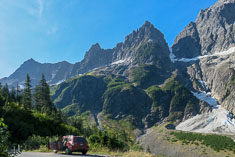
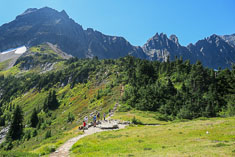
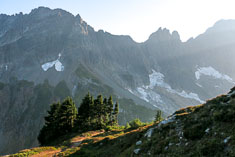 I started up around 10AM. The first mile of the trail switchbacks up through shady old growth
forest, mostly Pacific Silver Fir and Mountain Hemlock I think. I kept a bird list L+ but didn't have many species. By mid-August many of
the summer breeding visitors have either gone silent or started on their way home to the tropics,
or both. No flycatchers, no tanagers, no swallows. Not many bugs either; I don't know where they
disappear to but by mid-late August the biting flies aren't much of a problem even for me with my
reduced ability to swat them.
I started up around 10AM. The first mile of the trail switchbacks up through shady old growth
forest, mostly Pacific Silver Fir and Mountain Hemlock I think. I kept a bird list L+ but didn't have many species. By mid-August many of
the summer breeding visitors have either gone silent or started on their way home to the tropics,
or both. No flycatchers, no tanagers, no swallows. Not many bugs either; I don't know where they
disappear to but by mid-late August the biting flies aren't much of a problem even for me with my
reduced ability to swat them.
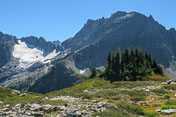
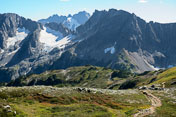
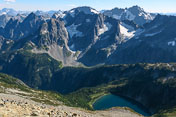
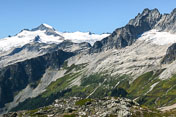 Sahale Arm is an anomaly in the north Cascades - a broad ridge ascending from 5400' at
Cascade Pass to 7400' at the Sahale Glacier. Most ridges in the region are impassable knife edges
a few feet wide but the crest of Sahale Arm is a gentle slope anywhere from 100 to 500 feet wide.
It's great for hikers, and views, and bears too when the berries are ripe.
Sahale Arm is an anomaly in the north Cascades - a broad ridge ascending from 5400' at
Cascade Pass to 7400' at the Sahale Glacier. Most ridges in the region are impassable knife edges
a few feet wide but the crest of Sahale Arm is a gentle slope anywhere from 100 to 500 feet wide.
It's great for hikers, and views, and bears too when the berries are ripe.
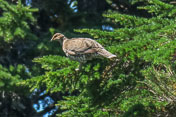
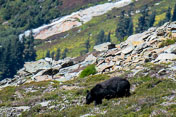
 I don't recall finding any huckleberries though I did see a bear. Ambling down the slope
100 yards away, it showed little interest in me. I were content that it was
content to not get too close. I imagine it resorts to watery crowberries when huckleberries are
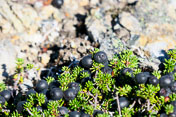
scarce. Black Crowberry is common on dry alpine knolls and some of the clumps I saw were
laden with fruit. It's hard to see how a bear could fatten up on them though.
I don't recall finding any huckleberries though I did see a bear. Ambling down the slope
100 yards away, it showed little interest in me. I were content that it was
content to not get too close. I imagine it resorts to watery crowberries when huckleberries are
scarce. Black Crowberry is common on dry alpine knolls and some of the clumps I saw were
laden with fruit. It's hard to see how a bear could fatten up on them though.
I did a separate bird list L+ for the hike up the arm, much of which is in Chelan rather than Skagit. With eBird, county matters, or at least it can matter if you want it to because eBird maintains separate lists at the county level, and each eBird location is assigned to just one county. It's a good data practice but inconvenient for areas like Sahale Arm which span two counties. Some of the Black Swifts zipping around over the arm surely crossed back and forth between Skagit and Chelan but I arbitrarily counted them just in Chelan. Nobody questioned me about it that I can recall.
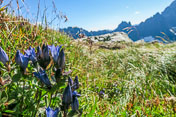
The Gentians were flowering, a sure sign of the end of summer.
View at the trailhead
Cascade Pass
Afternoon light above Cascade Pass
Lower Sahale Arm
Middle Sahale Arm
Upper Sahale Arm
Forbidden Peak from Sahale Arm
Sooty Grouse, Sahale Arm
Black Crowberry Empetrum nigrum, Sahale Arm
Black Bear, Sahale Arm
Gentian Gentiana calycosa, Sahale Arm
I did a separate bird list L+ for the hike up the arm, much of which is in Chelan rather than Skagit. With eBird, county matters, or at least it can matter if you want it to because eBird maintains separate lists at the county level, and each eBird location is assigned to just one county. It's a good data practice but inconvenient for areas like Sahale Arm which span two counties. Some of the Black Swifts zipping around over the arm surely crossed back and forth between Skagit and Chelan but I arbitrarily counted them just in Chelan. Nobody questioned me about it that I can recall.
The Gentians were flowering, a sure sign of the end of summer.
8/22/2015 Cedar River, Mount Margaret

 I met Ed and Delia at their house this morning at 8:30 and we drove down to the Cedar River mouth
where both Baird's and Stilt Sandpipers have been reported recently. Neither was among the 10
species of shorebirds we found there, but we got good close up photos of a Semipalmated Sandpiper on
the mud flats and somewhat more distant photos of a juvenile Sora foraging along the far bank Cedar
River, sheltered by a blackberry hedge from the jet wash of planes taking off from the adjacent
runway. We dropped our binoculars to plug our ears with our fingers as they roared overhead.
I met Ed and Delia at their house this morning at 8:30 and we drove down to the Cedar River mouth
where both Baird's and Stilt Sandpipers have been reported recently. Neither was among the 10
species of shorebirds we found there, but we got good close up photos of a Semipalmated Sandpiper on
the mud flats and somewhat more distant photos of a juvenile Sora foraging along the far bank Cedar
River, sheltered by a blackberry hedge from the jet wash of planes taking off from the adjacent
runway. We dropped our binoculars to plug our ears with our fingers as they roared overhead.


 I had planned earlier in the week to go down to Ocean Shores. A Lesser Sand Plover was hanging out
on the beach and I could have seen it if I had gone down on Wednesday. I didn't feel like going
alone so I stayed home instead and then was unhappy that I missed the sand plover and other year
birds down there. This morning I recognized again how the pleasure of company takes away the
disappointment of missing the target birds.
I had planned earlier in the week to go down to Ocean Shores. A Lesser Sand Plover was hanging out
on the beach and I could have seen it if I had gone down on Wednesday. I didn't feel like going
alone so I stayed home instead and then was unhappy that I missed the sand plover and other year
birds down there. This morning I recognized again how the pleasure of company takes away the
disappointment of missing the target birds.


 Distracted by peeps on a gravel bar a few hundred yards up from the lake, mostly Least Sandpipers I
think, we were late leaving the Cedar River so I was late for my haircut and late for lunch with
Darchelle and Ellen at the Royal Palm. The haircut wasn't quite what I wanted, hair too short and
beard too long, but I was too timid to ask her to trim my beard shorter. Darchelle had ordered
eggplant for me , normally a good choice but it was a little too salty. I ate too much nonetheless
so had to take a nap afterwards.
Distracted by peeps on a gravel bar a few hundred yards up from the lake, mostly Least Sandpipers I
think, we were late leaving the Cedar River so I was late for my haircut and late for lunch with
Darchelle and Ellen at the Royal Palm. The haircut wasn't quite what I wanted, hair too short and
beard too long, but I was too timid to ask her to trim my beard shorter. Darchelle had ordered
eggplant for me , normally a good choice but it was a little too salty. I ate too much nonetheless
so had to take a nap afterwards.
Juvenile Sora, Cedar River Mouth
Sora exercising, Cedar River Mouth
Sora, Cedar River Mouth
Yellow warbler in Butterfly bush, Cedar River Mouth
Wilson's Snipe, Cedar River Mouth
Semipalmated Plover, Cedar River Mouth
Western Sandpipers with Killdeer, Cedar River Mouth
Semipalmated Sandpiper, Cedar River Mouth
Around 5PM I set out for the Mount Margaret trailhead near Snoqualmie Pass. The mountains
were hazy from the smoke that has blanketed the Puget Sound all day long, tinting the sunlight
orange and coloring the sky white. Visibility was only about five miles; from Gold Creek, Alta was
visible but Chikamin Peak was not. I could smell the smoke when I started up from
the trailhead, like a campfire nearby. In the past week 250,000 acres have burned in the Methow and
Okanogan valleys. I grieve for the forests, which won't regain their diversity and beauty for
generations, if not centuries.
Mount margaret is my go-to spot for huckleberries and boletes but I found neither. The soil was actually damp in places so perhaps it is too early for the mushrooms. I think they usually come up around Labor Day. The huckleberry leaves were curling and turning red, probably from drought, and there were no berries at all.
Mount margaret is my go-to spot for huckleberries and boletes but I found neither. The soil was actually damp in places so perhaps it is too early for the mushrooms. I think they usually come up around Labor Day. The huckleberry leaves were curling and turning red, probably from drought, and there were no berries at all.
8/23/2015 Morning
I awoke this morning from a happy dream though I could not recall the details. When I sat up to get out of bed, I felt the weakness in my arms and was sad, realizing again that this is my reality, and from it there is no escape. Doctors can't fix it and there is no longer any magic in God.
I pulled my shorts up to my crotch and grabbed the waistband in back with my fingers, braced my knuckles on the edge of the counter and squatted down to into drop my butt my shorts. Then I turned around and with my left hand pinned the left side of the snap to the countertop, squatted down a bit to raise my shorts as high as they would go and with my right hand slid the right side of the snap across the countertop and into place on top of the left. It took several tries. Then I pressed down with all my strength using both thumbs to pop the snap together. After that the zipper was pretty easy. The belt buckle is tough so since I wasn't going out of the house I just left it for later.
My arms were feeling pretty good. I've noticed recently that my arms feel somewhat better the day after a hike so I try to to take advantage of that, this morning by cooking breakfast. I chopped and sauteed some sweet onion, added some morels that I froze back in May and some black sticky rice left over from a couple of days ago. Seasoned with salt, pepper, basil and nutmeg, it was quite tasty. I decided to try an omelet as well. I used to enjoy making them but now the physical effort is generally too much. Cracking the eggs I mangled one of them but was able to salvage it. Grabbing a fork with both fists, I pushed the yolks around the bowl a few times before getting up to speed. I beat them pretty well. I didn't even come close to dropping the pan while cooking the omelet but I turned the burner off a little too soon and had to finish it up under the broiler. I added tomato and cheese for the last minute. The eggs were nice and light but the flavor was a bit disappointing. I think maybe the tomatoes weren't sweet enough. Sitting in my little dining room with the yellowish sunlight slipping in through the bay windows, sipping my strong coffee and eating my morel-flavored rice and my so-so tomato omelet, I felt something akin to joy.
I awoke this morning from a happy dream though I could not recall the details. When I sat up to get out of bed, I felt the weakness in my arms and was sad, realizing again that this is my reality, and from it there is no escape. Doctors can't fix it and there is no longer any magic in God.
I pulled my shorts up to my crotch and grabbed the waistband in back with my fingers, braced my knuckles on the edge of the counter and squatted down to into drop my butt my shorts. Then I turned around and with my left hand pinned the left side of the snap to the countertop, squatted down a bit to raise my shorts as high as they would go and with my right hand slid the right side of the snap across the countertop and into place on top of the left. It took several tries. Then I pressed down with all my strength using both thumbs to pop the snap together. After that the zipper was pretty easy. The belt buckle is tough so since I wasn't going out of the house I just left it for later.
My arms were feeling pretty good. I've noticed recently that my arms feel somewhat better the day after a hike so I try to to take advantage of that, this morning by cooking breakfast. I chopped and sauteed some sweet onion, added some morels that I froze back in May and some black sticky rice left over from a couple of days ago. Seasoned with salt, pepper, basil and nutmeg, it was quite tasty. I decided to try an omelet as well. I used to enjoy making them but now the physical effort is generally too much. Cracking the eggs I mangled one of them but was able to salvage it. Grabbing a fork with both fists, I pushed the yolks around the bowl a few times before getting up to speed. I beat them pretty well. I didn't even come close to dropping the pan while cooking the omelet but I turned the burner off a little too soon and had to finish it up under the broiler. I added tomato and cheese for the last minute. The eggs were nice and light but the flavor was a bit disappointing. I think maybe the tomatoes weren't sweet enough. Sitting in my little dining room with the yellowish sunlight slipping in through the bay windows, sipping my strong coffee and eating my morel-flavored rice and my so-so tomato omelet, I felt something akin to joy.
8/25/2015 50 Mile Hike - Crystal Mt to Chinook Pass Tuesday (15 miles)
 Alicia wanted to celebrate her 50th birthday by hiking 50 miles with as many members of her extended
family as possible. Darchelle and I agreed to plan the expedition and serve as guides. To allow
more family participation, and perhaps also to facilitate taking the day off on Sabbath, we decided
to do four day hikes instead of a backpacking trip. Mount Rainier National Park, offering
spectacular scenery and located not too far from both Walla Walla and Seattle, made a logical choice
of venue for the event. Between the PCT and the Wonderland Trail we could pick a series of
point-to-point hikes without spending too much time relocating between hikes or running shuttles
from start to finish.
Alicia wanted to celebrate her 50th birthday by hiking 50 miles with as many members of her extended
family as possible. Darchelle and I agreed to plan the expedition and serve as guides. To allow
more family participation, and perhaps also to facilitate taking the day off on Sabbath, we decided
to do four day hikes instead of a backpacking trip. Mount Rainier National Park, offering
spectacular scenery and located not too far from both Walla Walla and Seattle, made a logical choice
of venue for the event. Between the PCT and the Wonderland Trail we could pick a series of
point-to-point hikes without spending too much time relocating between hikes or running shuttles
from start to finish.
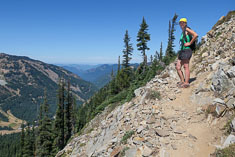
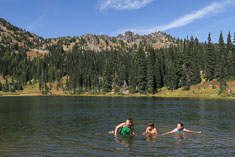
I don't think any of us wrote about our fifty mile hike at the time and the photographic record, while extensive, is not comprehensive. On this, our first day out, we met at Chinook Pass and left a car there then drove to Crystal Mountain. We hiked up the Norse Peak trail to the PCT then followed that south back to Chinook Pass. The weather was beautiful, and warm enough that some of the party went for a swim in Sheep Lake. I might have been among them, I don't remember. We camped at the White River CG that night and Darchelle and slept out in the open, sharing our blankets even though I don't recall that our relationship was public at that point, though we were engaged.
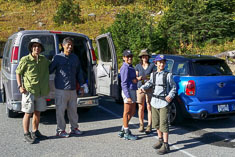
At the trailhead on day 1
Darchelle on the PCT above Crystal Mt
Swimming in Sheep Lake
I don't think any of us wrote about our fifty mile hike at the time and the photographic record, while extensive, is not comprehensive. On this, our first day out, we met at Chinook Pass and left a car there then drove to Crystal Mountain. We hiked up the Norse Peak trail to the PCT then followed that south back to Chinook Pass. The weather was beautiful, and warm enough that some of the party went for a swim in Sheep Lake. I might have been among them, I don't remember. We camped at the White River CG that night and Darchelle and slept out in the open, sharing our blankets even though I don't recall that our relationship was public at that point, though we were engaged.
8/26/2015 50 Mile Hike - Lk Eleanor to Sunrise Wednesday (10 miles)
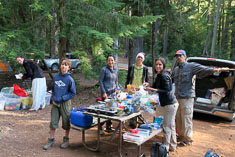
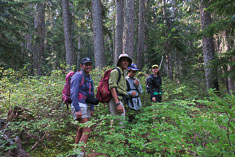
 For our second day out we jumped across the White River valley to the Lake Eleanor trail, a gentle
hike through old growth forest to the lake followed by a steeper climb up to the sloping plateau of
Grand Park, formed by a rhyolite flow early in the current mountain's history. Apparently the
current Mount Rainier was preceded by an earlier iteration. Why Grand Park is not covered in trees,
I don't know. The soil appears to be well-drained gravel, perhaps too well drained for trees though
they do manage to grow in some areas of the park.
For our second day out we jumped across the White River valley to the Lake Eleanor trail, a gentle
hike through old growth forest to the lake followed by a steeper climb up to the sloping plateau of
Grand Park, formed by a rhyolite flow early in the current mountain's history. Apparently the
current Mount Rainier was preceded by an earlier iteration. Why Grand Park is not covered in trees,
I don't know. The soil appears to be well-drained gravel, perhaps too well drained for trees though
they do manage to grow in some areas of the park.
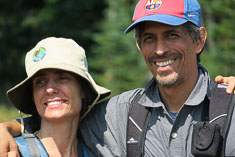
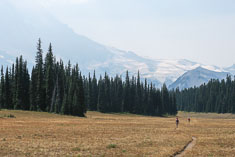
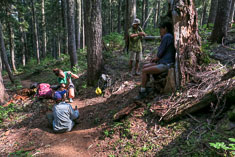
 The area, like Sunrise, is known for flowers but we didn't notice many. Too late in the year, I
guess. We tried to admire the views of the mountain but it was obscured by haze, perhaps due to a
distant fire, so we photographed each other instead and stopped for lunch near the upper end of
the park where the views were merely territorial. Gabriel hiked on ahead and it took us some time,
and some some help from a ranger once we reached the Wonderland Trail, to reconnect with him.
Daniel stayed with us and required a little encouragement during the slog up to Berkeley Park but
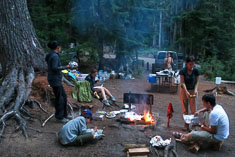
we all made it back to Sunrise and down the hill to our camp in time to roast vegetables and corn
wrapped in foil over the campfire.
The area, like Sunrise, is known for flowers but we didn't notice many. Too late in the year, I
guess. We tried to admire the views of the mountain but it was obscured by haze, perhaps due to a
distant fire, so we photographed each other instead and stopped for lunch near the upper end of
the park where the views were merely territorial. Gabriel hiked on ahead and it took us some time,
and some some help from a ranger once we reached the Wonderland Trail, to reconnect with him.
Daniel stayed with us and required a little encouragement during the slog up to Berkeley Park but
we all made it back to Sunrise and down the hill to our camp in time to roast vegetables and corn
wrapped in foil over the campfire.
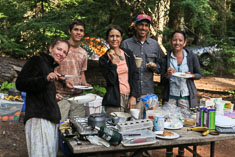
Fixing lunch in camp
On the trail to Lake Eleanor
Rest stop above Lake Eleanor
Alicia and Ricardo
Hiking in Grand Park
Supper in camp at White River CG
8/27/2015 50 Mile Hike - Sunrise to White River CG via Third Burroughs Thursday (10 miles)
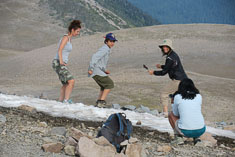
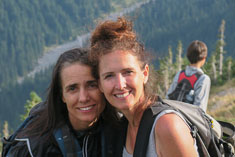
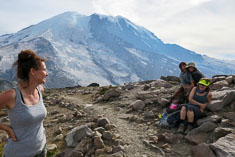 Photos reveal we started our hike this morning at Sunrise and took the low route past Shadow Lake
to First Burroughs. Alicia, Daniel and Darchelle found a snowbank to play on when we reached Third
Burroughs. Sandra, Bonnie and I watched. Ricardo and Gabriel must have tackled a different route
because they appear only in photos from the parking lot.
Photos reveal we started our hike this morning at Sunrise and took the low route past Shadow Lake
to First Burroughs. Alicia, Daniel and Darchelle found a snowbank to play on when we reached Third
Burroughs. Sandra, Bonnie and I watched. Ricardo and Gabriel must have tackled a different route
because they appear only in photos from the parking lot.
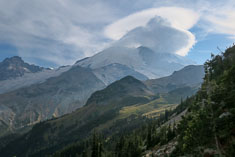
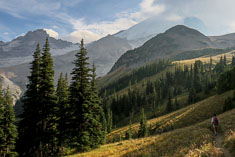 In my opinion the views of the mountain from the trail between Second Burroughs and the valley
can be some of the finest in the park and today they did not disappoint us. Darchelle and I had
done most of this hike back in June, the first time I'd taken that trail, and we'd run into a bear with
cubs about a mile up from the White River Campground. No bears today though, and like yesterday not
many flowers either, just great views of the mountain.
In my opinion the views of the mountain from the trail between Second Burroughs and the valley
can be some of the finest in the park and today they did not disappoint us. Darchelle and I had
done most of this hike back in June, the first time I'd taken that trail, and we'd run into a bear with
cubs about a mile up from the White River Campground. No bears today though, and like yesterday not
many flowers either, just great views of the mountain.
Breakfast in camp, White River CG
Playing on a snowbank
On Third Burroughs
Alicia and Darchelle
Mount Rainier from below Second Burroughs
Daniel hiking down from Second Burroughs
8/28/2015 50 Mile Hike - Frying Pan Ck to Box Canyon Friday (17 miles)
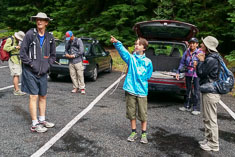
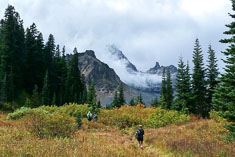
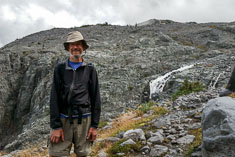 Richard did the full 17.5 miles today and struggled in the last mile or two so Darchelle and
Alicia picked up a couple of extra miles by hiking in to meet him. Darchelle and I were a mile
short anyhow, having accompanied the others only until lunchtime before turning around above Indian
Bar. We returned to the Frying Pan Creek trailhead and drove the car (cars?) over to Box Canyon.
Richard did the full 17.5 miles today and struggled in the last mile or two so Darchelle and
Alicia picked up a couple of extra miles by hiking in to meet him. Darchelle and I were a mile
short anyhow, having accompanied the others only until lunchtime before turning around above Indian
Bar. We returned to the Frying Pan Creek trailhead and drove the car (cars?) over to Box Canyon.
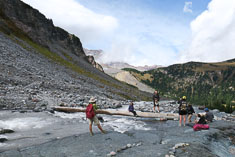
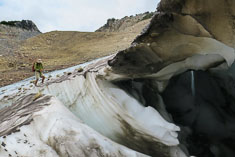
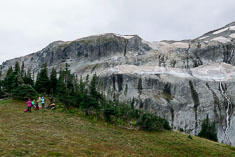 Gabriel, leading the way beyond Indian Bar, spotted the only Ptarmigan of the ptrip, though
habitat would suggest it was only a more common Sooty Grouse. It would be Gabriel again
a month
later who would find us our only Ptarmigan of the year ten miles away on Mount Fremont, so who
am I to doubt his Ptarmigan identification skills.
Gabriel, leading the way beyond Indian Bar, spotted the only Ptarmigan of the ptrip, though
habitat would suggest it was only a more common Sooty Grouse. It would be Gabriel again
a month
later who would find us our only Ptarmigan of the year ten miles away on Mount Fremont, so who
am I to doubt his Ptarmigan identification skills.
At the Frying Pan Creek trailhead
On the trail below Summerland
Brian above Summerland
At the log bridge above Summerland
Gabriel and schrund below Panhandle Gap
Lunch spot above Indian Bar
8/30/2015 50 Mile Hike - Grove of the Patriarchs and Pebble Creek
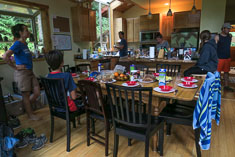
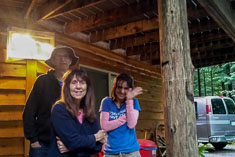
 For the weekend Darchelle had booked a cabin in Packwood large enough to sleep all of us so we
gathered there for Sabbath. Donna joined us there, and Marco, Monica and Marc came over in the
morning. Neither my photos nor my memories reveal what we did all day.
For the weekend Darchelle had booked a cabin in Packwood large enough to sleep all of us so we
gathered there for Sabbath. Donna joined us there, and Marco, Monica and Marc came over in the
morning. Neither my photos nor my memories reveal what we did all day.
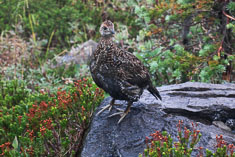
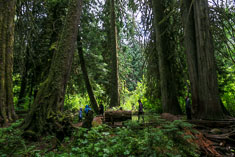
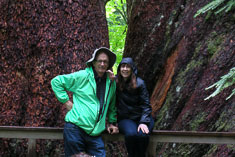
 Sunday was damp but we went out anyhow, first to walk through the Grove of the Patriarchs then
to explore the Visitor Center at Paradise. Gabe, Ricardo and I hiked up to Pebble Creek while the
others, having achieved the goal of fifty miles on Friday, hung out in front of the fireplace in
the lodge.
Sunday was damp but we went out anyhow, first to walk through the Grove of the Patriarchs then
to explore the Visitor Center at Paradise. Gabe, Ricardo and I hiked up to Pebble Creek while the
others, having achieved the goal of fifty miles on Friday, hung out in front of the fireplace in
the lodge.
Sabbath breakfast table in the cabin, Packwood
Family among old growth trees
Richard and Donna, Grove of the Patriarchs
Soggy Sooty Grouse above Paradise
Ricardo and Brian at Pebble Creek
Saying good bye at the cabin, Packwood
9/03/2015 Ocean Shores

 I'm still learning to tell our two Golden Plovers apart, and I had good opportunities to practice this afternoon at the
Oyhut Game Range L+
in Ocean Shores. I identified most of them as Pacific because their tertials reached
nearly to the tips of their primaries.
I'm still learning to tell our two Golden Plovers apart, and I had good opportunities to practice this afternoon at the
Oyhut Game Range L+
in Ocean Shores. I identified most of them as Pacific because their tertials reached
nearly to the tips of their primaries.


 After studying plovers for a couple of hours at the Game Range I drove over to the
beach L+.
After studying plovers for a couple of hours at the Game Range I drove over to the
beach L+.


 Before I'd even driven a mile on the hard-packed sand I spotted the bird I'd hoped to find.
Roosting among the Caspian Terns was a solitary Elegant Tern, a late-summer visitor to the Washington
coast from southern California. I found a few more over at Tokeland, but have not seen
any in the years since.
Before I'd even driven a mile on the hard-packed sand I spotted the bird I'd hoped to find.
Roosting among the Caspian Terns was a solitary Elegant Tern, a late-summer visitor to the Washington
coast from southern California. I found a few more over at Tokeland, but have not seen
any in the years since.


 I don't remember what inspired me to drive an hour out of the way to Tokeland, but on the
way back we photographed Red-necked Phalaropes, which normally migrate out at sea, in the pond at
Midway.
I don't remember what inspired me to drive an hour out of the way to Tokeland, but on the
way back we photographed Red-necked Phalaropes, which normally migrate out at sea, in the pond at
Midway.
Pacific Golden Plover (long tertials, short primaries)
American Golden Plover (short tertials, long primaries)
Selfie, Oyhut Game Range
Oyhut Game Range
American (L) and Pacific (R) Golden Plovers
Heerman's Gulls, Ocean Shores
Elegant Tern with Caspians, Ocean Shores
Caspian Tern, Ocean Shores
Semipalmated Plovers, Oyhut Game Range
Red-necked Phalaropes, Midway Beach
Brown Pelicans and Double-crested Cormorant, Tokeland
9/07/2015 Arranging flowers with ALS
 Yesterday at the Ballard farmers market, I bought a large bunch of flowers.
Unfortunately they were too top heavy even for the largest vase I had so this morning I decided to
trim the stems. Because I was unable to flex my arms to lift the vase into the sink, I climbed up
on to the low stool that I sometimes use for working in the sink. I pulled the flowers out of the
vase and trimmed the stems one at a time, pressing the handles of the scissors against the bottom of
the sink to make the cuts then replacing the stems in the vase. As I was finishing up the
arrangement I leaned over too far. The stool slid out from under my feet and I fell forward into
the sink. Unable to stop myself with my useless arms, my forehead hit the backsplash tiles as my
jaw struck the hot water handle and my shoulder slammed into the sunflower bouquet. Only the
flowers were damaged; I was fortunately not seriously hurt, just angry once again about this damned
disease.
Yesterday at the Ballard farmers market, I bought a large bunch of flowers.
Unfortunately they were too top heavy even for the largest vase I had so this morning I decided to
trim the stems. Because I was unable to flex my arms to lift the vase into the sink, I climbed up
on to the low stool that I sometimes use for working in the sink. I pulled the flowers out of the
vase and trimmed the stems one at a time, pressing the handles of the scissors against the bottom of
the sink to make the cuts then replacing the stems in the vase. As I was finishing up the
arrangement I leaned over too far. The stool slid out from under my feet and I fell forward into
the sink. Unable to stop myself with my useless arms, my forehead hit the backsplash tiles as my
jaw struck the hot water handle and my shoulder slammed into the sunflower bouquet. Only the
flowers were damaged; I was fortunately not seriously hurt, just angry once again about this damned
disease.
Deranged Flower
9/13/2015 Yellow Aster Butte

 The last hike of the summer was primarily an attempt to find White-tailed Ptarmigan but though
I traipsed through the high country north of Mount Baker for more than six hours,
I saw none. Not that there weren't compensatory rewards. The huckleberry bushes were
brilliant, the lighting dramatic and the landscape wild and scenic. And the marmots were adorable.
The last hike of the summer was primarily an attempt to find White-tailed Ptarmigan but though
I traipsed through the high country north of Mount Baker for more than six hours,
I saw none. Not that there weren't compensatory rewards. The huckleberry bushes were
brilliant, the lighting dramatic and the landscape wild and scenic. And the marmots were adorable.


 A marine layer moved in overnight and the mountains were obscured by a low stratus overcast which
was beginning to break up by the time I reached the trailhead. I missed the turn off the Mount
Baker highway and wasted a half hour trying to find it before finally checking the map. The 4 1/2
miles up to the trailhead were really rough. The trail itself was pretty easy, climbing pleasantly
through forest for a couple of miles before starting to break out into meadows below Yellow Aster Butte.
At 3.5 miles the trail crosses the shoulder of the butte and a side trail climbs steeply up
to the right to the summit. It's worth noting that the
WTA trail description
and the map don't
agree as to which summit is the real Yellow Aster Butte. The map names the first summit west of
Gold Run Pass as Yellow Aster Butte but that summit is relatively inaccessible. West of that summit
is a prominent sharp peak which is the highest point on the ridge. From that peak the ridge runs
southwest about a third of a mile to a steep but rounded summit capped with crowberry, mountain
heath and alpine huckleberry, the latter brilliant red this time of year. It is that rounded summit
which is the destination of the Yellow Aster Butte trail.
A marine layer moved in overnight and the mountains were obscured by a low stratus overcast which
was beginning to break up by the time I reached the trailhead. I missed the turn off the Mount
Baker highway and wasted a half hour trying to find it before finally checking the map. The 4 1/2
miles up to the trailhead were really rough. The trail itself was pretty easy, climbing pleasantly
through forest for a couple of miles before starting to break out into meadows below Yellow Aster Butte.
At 3.5 miles the trail crosses the shoulder of the butte and a side trail climbs steeply up
to the right to the summit. It's worth noting that the
WTA trail description
and the map don't
agree as to which summit is the real Yellow Aster Butte. The map names the first summit west of
Gold Run Pass as Yellow Aster Butte but that summit is relatively inaccessible. West of that summit
is a prominent sharp peak which is the highest point on the ridge. From that peak the ridge runs
southwest about a third of a mile to a steep but rounded summit capped with crowberry, mountain
heath and alpine huckleberry, the latter brilliant red this time of year. It is that rounded summit
which is the destination of the Yellow Aster Butte trail.


 It was a good day for accipiters, beginning with the burly Northern Goshawk which had cruised down
into the valley as I traversed below the Butte. Then when I gained the ridge
Sharp-shinned Hawks starting sailing by at a rate of about one per minute, repeatedly flushing a
flock of about 50 American Pipits. One pipit almost got caught. Among the Sharpies were at least a
couple of Cooper's Hawks, larger and more stable as they soared overhead.
It was a good day for accipiters, beginning with the burly Northern Goshawk which had cruised down
into the valley as I traversed below the Butte. Then when I gained the ridge
Sharp-shinned Hawks starting sailing by at a rate of about one per minute, repeatedly flushing a
flock of about 50 American Pipits. One pipit almost got caught. Among the Sharpies were at least a
couple of Cooper's Hawks, larger and more stable as they soared overhead.
After surveying the country, I elected to drop down into the basin northwest of the summit where tarns are scattered among ledge-capped knolls and colorful tents were scattered around the tarns. I crossed the basin and climbed steeply up the other side following a boot path north towards Tomyhoi Peak. After passing through a couple of tree bands I veered off to the left towards open ridges where Ptarmigan surely must dwell. Perhaps they do but I didn't see them.


 The morning stratus had re-formed as a stratocumulus layer which gradually lifted off the lower
summits as I ascended. Yellow Aster Butte itself came into the clear as I sat
eating lunch in the lee of a young Mountain Hemlock. A pair of feuding Sharpies shot by and a
Redtail soared down over the basin. Chilled after eating, I hiked on up the broad ridge
towards Tomyhoi until I came to a steep drop into a narrow pass. I carefully
followed a track down into the gap but I was blocked by a short scrambling step on the other side.
I could have made it up but I was concerned about getting back down so I turned around.
The morning stratus had re-formed as a stratocumulus layer which gradually lifted off the lower
summits as I ascended. Yellow Aster Butte itself came into the clear as I sat
eating lunch in the lee of a young Mountain Hemlock. A pair of feuding Sharpies shot by and a
Redtail soared down over the basin. Chilled after eating, I hiked on up the broad ridge
towards Tomyhoi until I came to a steep drop into a narrow pass. I carefully
followed a track down into the gap but I was blocked by a short scrambling step on the other side.
I could have made it up but I was concerned about getting back down so I turned around.
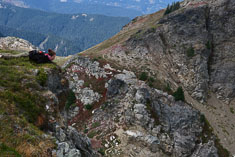
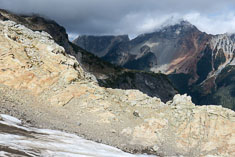
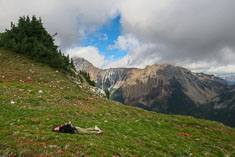 I hugged the east side of the ridge on the way down, stopped for a nap in a sheltered
meadow, descended off trail into the valley below the sharp peak on the ridge of Yellow Aster Butte.
As the cloud layer broke up I began at last to warm up in the sunshine. After climbing the
steep slopes up to the saddle, on the alert for Ptarmigan, I scrambled up the sharp peak. The trail up the peak was well-worn
but a bit intimidating without arms.
I hugged the east side of the ridge on the way down, stopped for a nap in a sheltered
meadow, descended off trail into the valley below the sharp peak on the ridge of Yellow Aster Butte.
As the cloud layer broke up I began at last to warm up in the sunshine. After climbing the
steep slopes up to the saddle, on the alert for Ptarmigan, I scrambled up the sharp peak. The trail up the peak was well-worn
but a bit intimidating without arms.


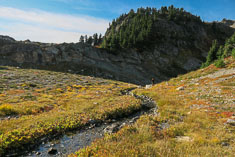 The views were great from both the sharp peak and the rounded summit. The clouds had lifted above
all the mountains except Shuksan and Baker. The late afternoon sun accentuated the glacier-smoothed
topography in the basin below as well as the reds and golds of huckleberries and meadows. I didn't
find a Ptarmigan but I did find joy there in the midst of such beauty.
The views were great from both the sharp peak and the rounded summit. The clouds had lifted above
all the mountains except Shuksan and Baker. The late afternoon sun accentuated the glacier-smoothed
topography in the basin below as well as the reds and golds of huckleberries and meadows. I didn't
find a Ptarmigan but I did find joy there in the midst of such beauty.


 Too soon I dropped into the shadow of the mountains and the colors faded to dusky greens
and blues. I thought I was done with photos for the day when I spotted a solitary
Band-tailed Pigeon perched on the leader of a young Mountain Hemlock by the trail. It waited
patiently while I fumbled with the camera and was still posing when I moved on.
Too soon I dropped into the shadow of the mountains and the colors faded to dusky greens
and blues. I thought I was done with photos for the day when I spotted a solitary
Band-tailed Pigeon perched on the leader of a young Mountain Hemlock by the trail. It waited
patiently while I fumbled with the camera and was still posing when I moved on.


 It was a long drive back to Seattle, something like three hours. Lorenzo's Mexican restaurant had
just stopped serving for the night when I reached Sedro Worley shortly after 9 PM so
I continued on home.
It was a long drive back to Seattle, something like three hours. Lorenzo's Mexican restaurant had
just stopped serving for the night when I reached Sedro Worley shortly after 9 PM so
I continued on home.
Summit per the trail description, Yellow Aster Butte
Hoary Marmot, Yellow Aster Butte
Trailhead parking, Yellow Aster Butte
Vine Maple and Alder above the trailhead, Yellow Aster Butte
Huckleberry and Mountain Ash, Yellow Aster Butte
Huckleberry, below Yellow Aster Butte
Tarn, Yellow Aster Butte
Trail up towards Tomyhoi Peak, Yellow Aster Butte
After surveying the country, I elected to drop down into the basin northwest of the summit where tarns are scattered among ledge-capped knolls and colorful tents were scattered around the tarns. I crossed the basin and climbed steeply up the other side following a boot path north towards Tomyhoi Peak. After passing through a couple of tree bands I veered off to the left towards open ridges where Ptarmigan surely must dwell. Perhaps they do but I didn't see them.
Spur northwest of Yellow Aster Butte
Tarns below Yellow Aster Butte
Yellow Aster Butte (shadow) and Goat Mountain (top center)
Darchelle contemplating the abyss
The only snow at 6200', Yellow Aster Butte
Darchelle taking a nap
Yellow Aster Butte
Meadows and Mount Shuksan, Yellow Aster Butte
Valley below Yellow Aster Butte
(from left) Goat Mountain and Mount Shuksan, Yellow Aster Butte
Mount Baker (center) and Yellow Aster Butte (left)
Selfie with Tomyhoi Peak, Yellow Aster Butte
Goat Mountain and tarn, Yellow Aster Butte
Mount Larrabee, Yellow Aster Butte
Band-tailed Pigeon, Yellow Aster Butte